

Microstructure evolution by defect accumulation during high-temperature ion implantation
Type of project: national programme
Duration: 2026 - 2028
 Project leader: Dr Andreja Šestan ZavašnikCode: Z2-70072 Coworkers: Dr Esther Punzón Quijorna, Dr Mitja Kelemen, Assist. Prof. Dr Sabina Markelj, Dr Primož VavpetičLaboratories: Laboratory for fusion research, MIC - Microanalytical Centre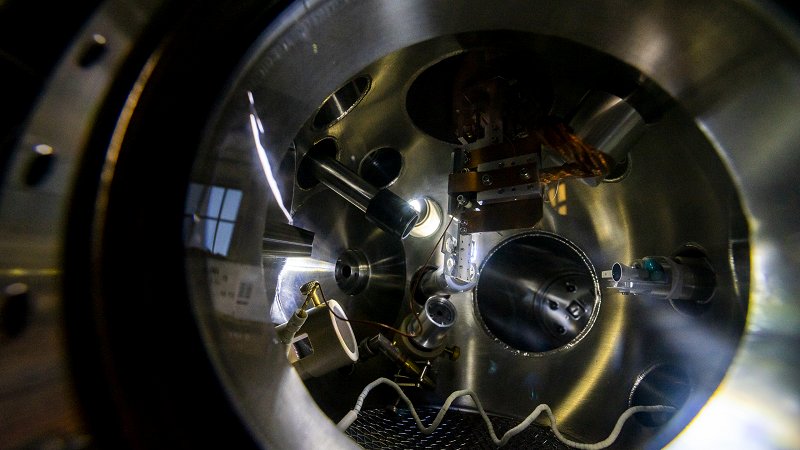
The D-T fusion reaction produces neutrons with energies of 14 MeV. These will cause structural defects in the crystal structure of W, which is the most promising material that will be used in direct contact with the plasma in the fusion reactor. Neutron radiation will simultaneously cause the transmutation of W into rhenium (Re). In five years, the content of Re in W will increase up to 3.8 atomic percent. The increase in the Re content in tungsten materials will drastically change the basic properties of tungsten (W), such as mechanical stability and thermal conductivity, which will negatively affect the operation and safety of future fusion reactors. In addition, D and T can accumulate in structural defects of the material, which can further deteriorate its properties. To study the behaviour of the material under fusion conditions, we propose the use of a state-of-the-art experimental conditions that are unique in the world and were developed in MIC/JSI laboratory but were never applied on W-Re alloys. Extensive studies have been performed on pure W, showing defect stabilization, so a direct comparison of the behaviour will be possible but with a much more detailed microstructure analysis performed under task.